National Book Award Winner Sherman Alexie Talks Politics with Stephen Colbert...
And there were some nice close-ups of his book cover.
Wednesday, October 29, 2008

Tuesday, October 28, 2008
The Latest Updates on The Purple Crayon...
Just saw a listserv post by The Purple Crayon's Harold Underdown. Here's what's new on his wonderfully useful website which include something like 300 articles and other materials providing information and guidance about writing, illustrating, agents, trends and more.
- A book review of Minders of Make-Believe by Leonard Marcus "one of the most engrossing books I've read in a long time--a fascinating history of American children's publishing," says Harold.
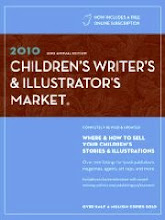
- A book reivew of 2009 CWIM, edited by yours truly, which Harold calls "an essential market guide. "
- Who's Moving Where updates (editors moving houses, leaving the business, or starting new jobs).
Monday, October 27, 2008
Hey Editors and Agents: We've Got Some Questions for You...
Here at Writer’s Digest Books, we’re in the process of updating our popular title Formatting & Submitting Your Manuscript and are looking for insight from agents/editors on how the industry is changing. Here are a few things we’re interested in knowing:
- How have queries and submissions changed for you in recent years? Do you request different information? Do you accept email queries? If so, do you prefer electronic or paper queries? How important is format and formality in electronic communication?
- What are your pet peeves and turnoffs?
- What are your do's and don'ts for writers?
- Have you changed how you select authors? How many of your authors are found through queries, and how many through other means? Do you want to hear about an author's platform?

- What recent changes in your market do you want writers to know about?
Writers are also welcome to comment and offer tips.
Friday, October 24, 2008
Ginee Seo Resigns from S&S...
Publishers Weekly reports:
Ginee Seo, v-p and editorial director of Ginee Seo Books, an imprint of Atheneum Books for Young Readers at Simon & Schuster, has resigned from her position with the publisher, according to an internal memo sent earlier this week by Atheneum v-p and publisher Emma Dryden.The short PW piece recalls some other recent changes in editor-driven children's imprints:
The past year has seen several changes at editor-driven children’s imprints at major houses, including the resignations of Laura Geringer and Joanna Cotler from their eponymous imprints at HarperCollins, as well as the formation of two new imprints, HarperCollins’s Bowen Press, headed by Brenda Bowen, and S&S’s Beach Lane Books, with Allyn Johnston at the helm.Here's the link to the full article.
Blog of the Week:
Annette Gulati's The Writing Wild Life... Annette Gulati started blogging (hesitantly, she says) just over a year ago “I kept hearing over and over by editors that even unpublished writers needed to create a web presence. I already had a website, but there was something about the blogging community that lured me in. I was reading other author blogs and I enjoyed following their journeys. I also loved the fact that there were so many friendships out there.”
So Annette created The Wild Writing Life as a way to chronicle her writing journey, what she calls “the trek I’m taking through the sometimes perilous jungle of children’s publishing.” But the purpose of her blog, she says “has sort of grown into finding a place in this community, and having the opportunity to talk about children’s literature with others who are as passionate about it as I am. My blog is really a smattering of things: relating industry news, some book reviews, author interviews, sharing my own successes and failures. I feel sort of like the parrot who sits atop a tree overlooking the jungle and knowing exactly what’s going on, but with the goal of someday being right down there with the others in the thick of it all.”
Annette is well on her way to descending from that tree top. Last year she won the Barbara Karlin grant for picture book writers from SCBWI. “Picture books have always been my first love,” she says. Winning the grant “was a tremendous boost of confidence for me. I have numerous picture books in various stages of development, but I’ve also written several easy readers and chapter books. I also love writing for children’s magazines.”
Thursday, October 23, 2008
Debut Author of the Month:
Kristin O'Donnell Tubb...
Set in east Tennessee in 1934, the formation of the Great Smoky Mountains National Park drives Autumn Winifred Oliver, pitting the title character against loggers, farmers, and volunteers from the Great Smoky Mountains National Park who all want her home for their own uses.
Here Kristin talks about getting The Call from her editor (in an unusual setting), her revision process, doing research for historical fiction, and more.
If you're in the Nashville area, you can attend Kristin's book release tonight at 6 p.m. at Davis-Kidd. (Judging from what a delightful interview this is, I'm sure it will be a fun event!)
Share the details of how you got your first book deal. How did you end up with Delacorte?
I met my editor at an SCBWI conference in September 2006, where she critiqued the first three chapters and requested the full manuscript. A few months later, I got The Call. But mind you, like Autumn, I sometimes do things different:
THE SCENE: Early February, 2007. A 212 area code pops up on my ringing cell phone. I am nine months pregnant. I am AT THE OB/GYN.
Wendy: "Hello, Kristin? It's Wendy Loggia from Random House."
Me: "Oh my gosh! It's so good to hear from you! I'm at my gynecologist's office right now."
Wendy: silence
Me: "Oh, um--I should say, I'm not in the office right now--I mean, I am, but I'm checking out. I'm done." Shut up Kristin. "I mean--I'm scheduling my induction for my new baby. I was newly pregnant when we met, remember?" Shut UP, Kristin. "Everything's great! Healthy baby! I'm scheduling his arrival right now. That's why I'm at...my...OB's office..."
Wendy: laughing "I think this is a first for me."
Me: unbelievably mortified "Uh, me too?"
Wendy: "So I wanted to talk to you more about this wonderful story you sent me..."
And that was that! There, in my OB/GYN's office, I was offered my first book deal. Two weeks later, my son was born. It was one heckuva month.
You revised your manuscript on your editor’s request before you got a contract then went through more revision after you signed. Tell us about your revision process. What did you learn?
Autumn was revised four times with my editor before it reached the state that hit shelves on October 14. The first revision was indeed prior to getting a contract, so whenever I hear a writer ask, “Should I really put more work into this without a contract?,” I’m the one shouting, “Yes! Absolutely! Do it!” (Sidebar: I later found out that many editors simply won’t offer a contract to a first-time author without requesting a round of revisions first. Editors need to know that: one, you can revise, and two, you’re willing.)
My revision process goes as follows:
- I receive an email from my editor, alerting me to the fact that my next round of revisions is headed my way. Feel a flutter of panic in stomach.
- I receive the packet, along with a three-page, single spaced letter alerting me to the massive changes my editor would like to see. “No way,” I think. “I cannot complete all of this by this deadline!” Full-on panic ensues. Much chocolate is consumed.
- A day or so passes. I review the letter again. “That’s no so bad,” I think. And, “Oh, right! That’ll work so much better! Why didn’t I think of it?”
- An outline of all changes is constructed, lumping like thoughts/characteristics together. Brainstorming begins.
- The old manuscript grows stronger as, item by item, each change is made.
- I mail the revised manuscript back to my amazingly brilliant editor, before deadline.
- I reward myself with chocolate.
Your book just released last week. Tell me about your promotional events?
First, I threw a virtual launch party both at my blog and at the Class of 2k8 blog. The day of my release, October 14th, I’ll was a guest speaker at an Educator’s Appreciation Event at Barnes & Noble in Franklin, TN. My launch party--a real, live one, with people and food and everything--is today, October 23rd, at 6 p.m. at Davis-Kidd Booksellers in Nashville, TN. Throw in a couple of school visits, the Southern Festival of Books, and a guest room filled with my very happy parents, and you’ve pretty much got it!
One online reviewer said of your character Autumn: “Her problem seems to be convincing everyone else that it’s Okay for her to be different. That’s her internal struggle—one that’s familiar to almost all of us.” What drove you to create this spunky, free spirited character?
Until I wrote Autumn, I never quite understood those writers who talked about their characters like they were real people. I respected them, yes, but truly, I thought those authors were so eccentric: “I see. So your character told you she didn’t want to go hunting because she’s considering becoming a vegetarian. Hmm…”
But then I got the idea to write a story set in Cades Cove, TN, which is now a part of the Great Smoky Mountains National Park. I did the research first, and found that the people who lived in the Cove and throughout the Smokies prided themselves on pulling the biggest prank, telling the tallest tale. This, mixed with a heaping dose of Southern religion. Autumn grew out of that research, and once she got rolling, she dragged me by my shirt collar through the story. I am now a convert.
Do you do things different?
I wish I could shout, “Absolutely! I’m as different as they come!” but truly, I’m not. We’re all a little bit different, but a lot the same. I think we sometimes forget how alike we all truly are.
You have a writers group, correct? You’re also in the Class of 2k8. Can a writer do it alone?
I don’t believe a writer can do it alone. Well, maybe if you’re Steinbeck or Frost or some other rare genius, then yes, you can walk this path solo. But a good writers group is far more than a collection of people who mark up your manuscript; they challenge you to make your ideas better. They cheer your highs and give you chocolate when you hit your lows. And the Class of 2k8 has been wonderful in that it’s been a support system for those of us going through publication for the first time. (And yes, there are as many highs and lows on this side of the contract as there are on the other side.) Then, too, is the simple idea that two (or in the case of my writer’s group, four) heads are better than one. More people watching the business, researching CWIM, and recommending good reads is always a plus. So even if you could do it alone, why would you?
Why do you love research so much? Do have any tips for researching historical fiction?
Ah, man, the research! (Can you hear the sigh?) Research is like panning for gold; you dig and search and sift until you stumble upon a little nugget that is just so lovely you know it must be a part of your story, and so you string it together with the other gorgeous little gems you’ve found. I love the dizzy feeling you get when the microfilm is whizzing toward an article that sounds promising. I love musty yellow books and photographs that can only be handled while wearing gloves. I love that a newspaper article written in 1910 sounds nothing like a newspaper article written in 1971. Even if what you find isn’t true (“Pall Malls are good for you!”), it was true to the people who first read it in 1934. It is life, preserved.
Three of my favorite tips for researching historical fiction (These of course don’t apply to those of you who write about the Iron Ages, but if 20th century Americana is your thing…):
- Find ads from the time period to get an idea of what the cars looked like, what kitchens looked like, what clothes looked like.
- Read the classified ads. These not only show the kinds of goods for sale, but were written by everyday folk (i.e., not reporters), so the vocabulary can be unforgettable.
- Ask your librarian for help on specific questions. My local librarian loves it when I walk up with a question like, “How much was rent for a two-room apartment in Chicago in May, 1910?” They live for that stuff. Really. That’s why they rule the world.
Writing for internationally known characters such as Scooby-Doo and Strawberry Shortcake is like getting a crash course in voice. Each character is so distinct and recognizable that you must do a lot of research before writing for them, so that you capture them accurately. And there are usually several gatekeepers that monitor each license--as there should be--to make certain that the text rings true. It sounds like a lot of work, and it is, but it’s a blast, too! Another benefit is learning to work under extremely tight deadlines. Because of all those aforementioned gatekeepers, each person needs to review the text a few days before the next person does, which makes some turn-around times quite tight--like, a week or so to write 64 pages.
The saying, “right place, right time,” could be a writer’s mantra, and certainly applies to how I first started working with Dalmatian Press. Dalmatian holds the rights to many well-known licensed characters for coloring and activity books. I met my editor at a conference and began writing for them shortly thereafter. Yet another example of getting yourself and your work in front of people! The good news is that once you’ve proven yourself in this arena, it’s not difficult to find new gigs. Publishers are always looking for people who can pen licensed characters.
What else are you working on?
I have two works-in-progress at the moment. The first is Selling Hope (Or, Gaining Glorious Asylum from Mr. Halley’s Fiery Beast). In May 1910, Halley’s Comet passed by Earth; it passed so close, in fact, that Earth actually passed through the tail of the comet. Mass hysteria ensued, much like the panic of Y2K. It was considered the first case of global paranoia, because it was the first time that the media (i.e., newspapers) reached enough people to feed the fear. Hope, an entrepreneurial vaudevillian, sees an opportunity to cash in on this fear by selling anti-comet pills. (And yes, that really happened. Another gem found!)
The other story I’m working on will, I hope, be attractive as a series. Haunted Melody: A Stop the Presses! Mystery stars Eleanor Roosevelt Pitt, a socially awkward but lovable girl who is obsessed with investigate reporters. She’s so entranced, in fact, that she starts a school newspaper, and manages not only to solve the mystery of the ghost in the music room, but get her fellow students enamored with journalistic truth as well.
And oh, I’m always working on school lunches and dirty diapers! (Not at the same time…)
Any advice to those seeking publications, particularly middle grade writers?
Aside from the Top Two Biggies (Read middle grade and write, write, write--in that order), I’d recommend attending conferences. Except for magazine articles, every writing gig I’ve ever landed has been the result of attending a conference. Research conferences in the CWIM, and take advantage of those manuscript critiques! (Yes, they cost extra, but this is your dream, right?!) When you find out which editors will be at a conference you’re attending, go back to your CWIM to see what kinds of books their houses publish. Google the editors. Read the books they have edited. If you have something similar in your files, submit it for critique. Get out of your office and market yourself--editors want to know that you’ll work hard to promote your book, and the best way to show them you will is to work hard to promote yourself.
Wednesday, October 22, 2008
Editor Interview:
Andrew Karre... Just a few weeks ago Andrew Karre moved from his position as acquisitions editor at YA-only Flux to assume the role of editorial director at Lerner Imprint Carolrhoda Books. Here Andrew talks a bit about his transition and his new job and offers advice to authors whose editors relocate.
Why the move from Flux to Carolrhoda? How is your new position different from your old one?
First off, it was not an easy decision. Working for Flux has been a joy and an adventure at nearly every turn. I am enormously proud of those books. Flux has some limitations for a children’s book editor, though, namely in the focus on YA fiction. I adore YA novels, but I honestly could not see myself acquiring them exclusively for the next decade. It just seemed unbalanced. My hope was that one day we’d be able to grow and branch out to the full spectrum of children’s literature, but when the opportunity came to step into a directorial role at an imprint that already had what I wanted (and that was part of an established children’s publisher a few miles from my home) . . . well, it was not an opportunity I could pass up.
Was it tough to leave Flux and particularly your Flux authors?
Agonizing. Absolutely horrible. There’s never a good time to leave a list in progress. The day before I gave my notice, we got that awesome notice on PW’s ShelfTalker blog. I knew there would be books that I was dying to edit that I would not be able to. There were books that were about to come out that I was convinced would be thrillingly successful. And of course it is such an amazing group of authors. They made almost every day interesting.
What's your advice to authors whose editors relocate?
In general, I would say this is where you really want your agent to be watching out for you. If you don’t have an agent, I would firmly but politely make sure I got as much information about The Plan of Succession, assuming there is one, as possible. At a minimum, get some other phone numbers and email addresses of other people in the house who might be able to answer questions. It isn’t necessarily a cause for panic, though. I have now happily inherited lovely lists of books twice in my career. I re-signed and had ongoing, productive relationships with several authors that Megan Atwood left me at Flux and I expect to have the same here at Carolrhoda.
In Flux’s particular case, my only concern is that authors will like Brian better than they liked me. Once they finally hired Brian Farrey to take the spot, I ceased to be concerned. The authors at Flux are in good hands.
What can you tell us about the Carolrhoda line? What types of books do you publish? Will you be making any changes as editorial director?
Carolrhoda is one of Lerner’s trade imprints. We do a couple dozen books a year and they range from picture books to YA, fiction and nonfiction. The emphasis is on books of extremely high quality that have a general trade audience. Recent successes include Sally Walker’s Sibert-award-winning Secrets of a Civil War Submarine and Almost to Freedom by Vaunda Micheaux Nelson and illustrated by Colin Bootman, which won a CSK Illustrator honor. Carolrhoda has won awards and starred reviews at every level of children’s publishing.
Carolrhoda has a long tradition and I won’t make changes lightly, but I do have my own style and my own ideas (especially about YA) and those won’t go away. I like being online and part of the broader conversations about books, so that will inevitably be part of what I do here.
Are you open to submissions from authors? What are you looking for?
Lerner does not consider unsolicited submissions. From time to time, we’ll make specific requests for certain kinds of books.
You blogged while at Flux. Is there a Carolrhoda blog?
At the moment, I’m blogging here. Any news relating to me and Carolrhoda will be there until we get a Carolrhoda blog going.
Tuesday, October 21, 2008
I'm Already Getting Excited About the SCBWI NYC Conference... I just got some scoop on the lineup of editors, agents and keynote speakers for the 10th Annual SCBWI Winter Conference in New York City which will happen January 30-February 1. I'm not at liberty to spill the beans, but let me tell you--it's a great faculty.
So, everyone: Mark your calendar for November 5. That's the first day to register for the event. (You can register on the SCBWI website.)
I'm certain that if you go:
- You will learn things.
- You'll make valuable connections.
- You'll meet me because I'm pretty sure I'll be there.
Monday, October 20, 2008
New Link on My List: Cheryl Klein's Talking Books...
Last week when I spoke to a group of writers at a local library, a few of them mentioned how much great information they found on Arthur A. Levine Books Senior Editor Cheryl Klein's website. I've just added her site to my "Alice Recommends..." links list.
Check out Cheryl's conference presentations covering things like plot, revision, and finding a publisher, as well as info on on queries, books she's worked on, a recommended reading list and lots more. (There's even a little Harry Potter thrown in here and there).
Also visit Chery's Blog, Brooklyn Arden. (Her most recent post is on plot problems.)
Friday, October 17, 2008
Blog of the Week:
Susan Gray's Gottawrite Girl...
"I started blogging to better live and breathe children's literature," says Susan Gray. "Gottawrite Girl is my shrine to the genre. It features everything I love reading as an aspiring author, from interviews and publishing news, to musings on the writing life."
Susan, whose day job writing for a DC non-profit doesn't satisfy her yearning to write from the heart, says she "wanted to get closer to 'my people,'" through blogging. "Gottawrite Girl lets me create my ideal writing life! My best life-moment sprouted from Gottawr ite Girl. I finagled my way into the National Book Fair as press and interviewed Katherine Paterson. Slam dunk of a day. I'm also making silly-wonderful friends! And I'm supporting my fellows with every interview."
Facebook, Susan says, has been invaluable for bolstering her blog. "I have a happy number of Gottawrite Girl 'fans' that I constantly update. And it's a great way to attract author interviews."
When she's not b logging, Susan is working on her first YA novel, and writing for Lucy Magazine. "My trembling but tenacious dream? That happy God-coincidences like this will include my novel becoming real. I will collapse," she says.
Thursday, October 16, 2008
Busy Day--Just Catching Up on My News...
I've spent the better part of my workweek--and pretty much my entire workday today--looking over a book that's about the go to the printer, so now, at 9 p.m., I'm just getting time to check on publishing news. Here are a few things that might interest you:
- The weekly PW Children's Bookshelf came out today. If you don't subscribe, sign up!
- The GalleyCat blog on MediaBistro has an interesting discussion of book reviews going on. (Did I mentioned that during the Portland Kidlitosphere conference, none other than Eric Kimmel declared to online children's book reviewers: You are so important--publishers need you. Not in those exact words, but that was the gist of it.)
- GalleyCat also has a post on press releases which I actually didn't find all the interesting (well, it's not that it's uninteresting, it's just that there's an awful lot of links
 and instructions), except that it features the cover of Martha Brockenbrough's Things that Make Us [Sic]. And since I saw on facebook there was a book release party for the book today, I feel I should show her cover on my blog, too. (Plus I just got my copy of [Sic] in the mail today. Yeah Martha!)
Wednesday, October 15, 2008
National Book Awards Finalists Announced... The National Book Foundation recently announced this year's finalists for the National Book Awards. Here is the five titles up for the Young People's Literature award chosen from among 274 nominees:
Laurie Halse Anderson, Chains (Simon & Schuster)
Kathi Appelt, The Underneath (Atheneum)
Judy Blundell, What I Saw and How I Lied (Scholastic)
E. Lockhart, The Disreputable History of Frankie Landau-Banks (Hyperion)
Tim Tharp, The Spectacular Now (Alfred A. Knopf)
The judges for young lit include Daniel Handler (chair), Holly Black, Angela Johnson, Carolyn Mackler and Cynthia Voigt. (And yikes--I haven't read any of these yet--I better get on the stick. I like to make predictions)
Follow this link to see the nominees in all categories. And note the covers of the fiction and nonfiction titles. Is it just me or are they collectively dark and depressing looking? They all look like a terribly dreary day. And the titles of the nonfiction picks make me feel like curling up in the fetal position under my covers and not leaving bed for a few days.
Tuesday, October 14, 2008
Local SCBWI Meeting at the Library...
Tonight I'm attending the local meeting of SCBWI members that takes place at the Sharonville Library branch here in the Cincinnati area at 7 p.m.--I'm the group's invited guest for their October gathering.
I really enjoy attending meetings like these. It's great to reconnect with the local writers, a number of whom are published authors. I like to hear about what they're doing and discuss all things children's publishing with them.
Most of all, I love the chance to get to the library. I love the quiet, the smell of the books, the children's section, all the people reading. But must confess that I haven't been to a library since last year--the last time I spoke to a library group. I go to the bookstore all the time. (Murray and I hang out there regularly.) I buy lots of books. I get lots of books for free. I just never think about checking out a book. Does a library card expire?
I think next time Murray bugs me about going to the bookstore (he really just wants a new Thomas train and some chicken fingers from the cafe) maybe I'll take him to the library instead. He's four--he should have his own library card. The problem is, I don't think he'd be cool with the concept of giving books back. If he brought a book home, I'm sure he'd assume it's his forever. (We've been down this road with DVDs a million time. He insists, "They aren't Blockbuster's; they're mine!")
I guess it's worth a shot.
Monday, October 13, 2008
Fun with Acronyms: Meet the other CWIMs...
Every day I get several Google alerts. Of course I have one set up for my name. (Who doesn't?) I also get one for CWIM, which mostly includes references to my book. But not always--and I've been keeping track of them. (And I might have also done some googling for non-my-book CWIMs when I was bored.) I will now share my list (with descriptions mostly using made up words):
- Covenant Warriors International Ministries (religiousy)
- Command Work Information Management (techie)
- Cetera Work Information Manager (also techie)
- Christian Women in Management (religousy + businessy)
- Colorado Women in Music (musicy)
- Chris Woollam Icon Magazine (newsy)
- Color Wheel Index Mark (printery)
- Corwyn's World Instant Messaging (chatty)
- Convergent Work Integration Manager (businessy)
- China Water Institution Management (environmenty)
- Climbing Works International Masters (outdoorsy)
- Cat Who Isn't Mine (cat sittery)
Friday, October 10, 2008
Blog of the Week:
Johanna Wright's what's new on JohannaWright.com...
In addition to a portfolio, a bio page, a link to her etsy store and other standard artist's website features, illustrator Johanna Wright offers a wonderfully visual blog on JohannaWright.com. Johanna says blogging allows the public to get to know her, feel connected with her artwork, and follow her career, wherever it may go.
"As an illustrator, a website is key. I feel like having a blog keeps people connected to my work in a way that they haven't been able to be in the past," she says. "I lived in New York for many years, and spent four of those years selling my artwork on the streets of Manhattan. Sitting on the street was a great way to connect with thousands of people, and get them interested in my art on a personal level. Now, blogging has replaced that for me. I can spend the day painting in my studio, record some of my artwork in a blog post, and still connect to more people than I have in the past."
Johanna say she feels like she's "in a really happy place creatively." Her first book, Secret Circus, is coming out with Roaring Brook Press in spring '09. Two other RBP titles she wrote and illustrated follow in 2010, Bandits and Rabbits on Skates. And she illustrated Clover Twig, by Kaye Umansky, also slated for spring 2009.
"I feel like there is a small group of blog readers that have followed my path to this place. That's so great to me! It gives me the freedom to do more of what I love to do, and spend less time trying to get people invested in what I'm creating."
If you enjoy her work and would like to keep up with what Johanna's doing, you can sign up for her email newsletter. I did--I think her style offers the perfect mix of warmth and wonder.
Subscribe to:
Posts (Atom)


 Posts
Posts


